Home › Food storage guides
Thanksgiving leftovers: how long they're safe and how to store them
Short answer: get leftovers into the fridge within 2 hours of cooking (1 hour if it's above 90 °F), in shallow containers. They keep 3 to 4 days in the refrigerator or 3 to 4 months in the freezer for best quality. Reheat everything to 165 °F, and bring gravy, soups and sauces to a rolling boil. That's the USDA Food Safety and Inspection Service (FSIS) guidance.
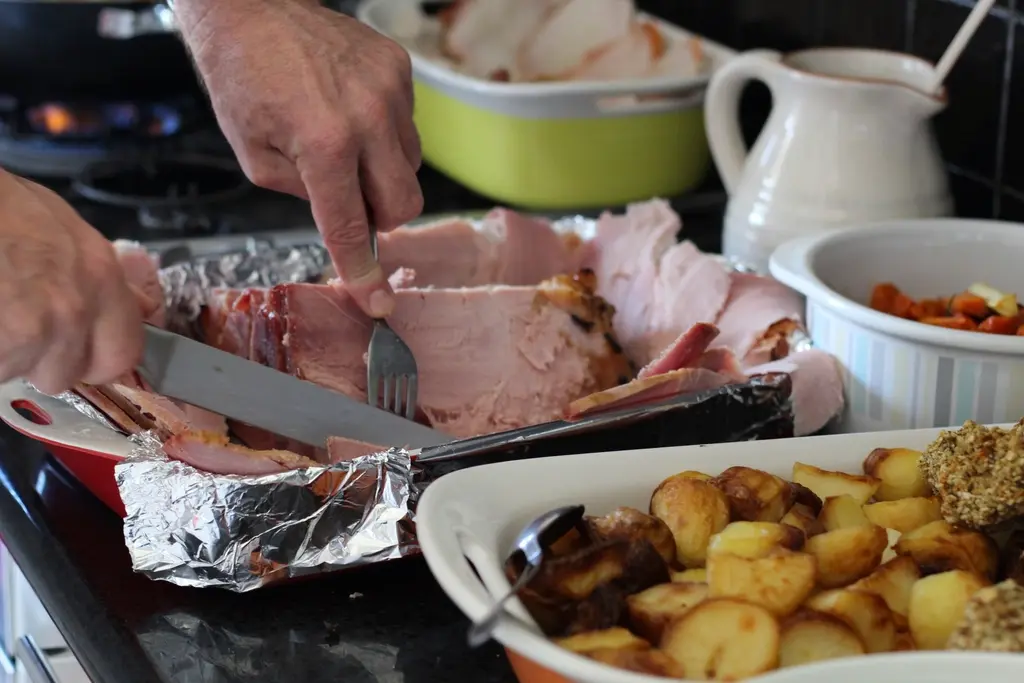
The big meal is the easy part. The risky part is the turkey sitting out through the football game, and the stuffing nobody remembers putting away. Here is what USDA FSIS says, step by step, so you can enjoy the sandwiches without guessing.
The 2-hour rule (start the clock when the food comes off the heat)
FSIS explains that bacteria grow rapidly between 40 °F and 140 °F, the range it calls the "Danger Zone." Leftovers must be refrigerated within 2 hours of cooking, or within 2 hours of being taken out of whatever was keeping them warm. If perishable food has been sitting at room temperature longer than that, FSIS says to throw it away. On a hot day above 90 °F, the limit drops to 1 hour.
A practical trick: when you sit down to eat, set a phone timer for 90 minutes. When it goes off, start packing up, before the pie comes out.
Cool it fast: shallow containers and smaller pieces
A whole turkey or a deep pot of gravy cools slowly, and slow cooling gives bacteria time to multiply. FSIS recommends dividing large amounts of food into shallow containers so they reach the safe refrigerator temperature of 40 °F or below as quickly as possible.
- The turkey: don't put the whole carcass in the fridge. FSIS says to cut the turkey into smaller pieces; slice the breast meat, while legs and wings may be left whole.
- Stuffing: if it was cooked inside the bird, take it out and refrigerate the turkey and stuffing within 2 hours, in shallow containers (FSIS, "Turkey Basics: Stuffing").
- Gravy, soup and big casseroles: split them into several smaller containers instead of one big one.
- Hot food is fine in the fridge. You don't have to wait for it to cool on the counter. FSIS says hot food can go directly into the refrigerator, or be chilled quickly in an ice or cold water bath first.
Cover everything, wrap it airtight or seal it in containers. That keeps bacteria out, holds moisture in and stops the cranberry sauce from tasting like onions.
How long do Thanksgiving leftovers last?
| In the refrigerator (40 °F or below) | 3 to 4 days |
|---|---|
| In the freezer | 3 to 4 months for best quality |
| Left out at room temperature | 2 hours maximum (1 hour above 90 °F) |
| Reheat to | 165 °F; gravy, soups and sauces to a rolling boil |
FSIS notes that frozen leftovers stay safe indefinitely, but they lose moisture and flavor the longer they sit in the freezer, which is why 3 to 4 months is the quality target. If you hosted on Thursday, Monday is a good "use it or freeze it" day. Freeze what you won't eat by then, in meal-size portions, and label each container with the date.
Free printable: the food safety numbers on one page
Our one-page cheat sheet puts key USDA-based numbers where you can see them: what you can safely put up at home, the "don't can" list and pressure by elevation. Stick it on the fridge next to the turkey sandwiches.
Get the free cheat sheet →Based on USDA guidance · printable PDF
How to reheat leftovers safely
FSIS says reheated leftovers should reach 165 °F, measured with a food thermometer. Bring sauces, soups and gravies to a rolling boil. Cover the food while you reheat it; that keeps it moist and helps it heat all the way through.
In the microwave, FSIS recommends covering and rotating the food, arranging it evenly in a covered microwave-safe glass or ceramic dish, adding a little liquid if needed, and venting the lid so steam can escape. Microwaves have cold spots, so check the temperature in several places after a short rest.
You can also reheat frozen leftovers without thawing them first; it just takes longer.
Thawing frozen leftovers
FSIS lists three safe ways: in the refrigerator, in cold water, or in the microwave. The fridge is slowest but keeps the food safe the whole time, and you then have 3 to 4 days to use it. With cold water, the food must be in a leak-proof bag, and it should be cooked before refreezing. Food thawed in the microwave should be heated to 165 °F right away. Skip the kitchen counter.
Have a question on Thanksgiving Day?
The USDA Meat and Poultry Hotline answers food safety questions about meat, poultry and egg products at 1-888-MPHotline (1-888-674-6854) or MPHotline@usda.gov. FSIS lists regular hours as Monday through Friday, 10 a.m. to 6 p.m. ET, and says the Hotline is open on Thanksgiving Day from 8 a.m. to 2 p.m. Hours can change, so check the FSIS Thanksgiving page before you call.
If a storm knocks out the power over the holiday weekend, see how to store food without a refrigerator. And if you like the idea of a pantry that keeps without the fridge at all, our Lost SuperFoods review looks at a book on old-time food storage.
Frequently asked questions
Is turkey still good after 5 days in the fridge?
USDA FSIS says refrigerated leftovers should be used within 3 to 4 days. After that, throw them out. If you know you won't finish them in time, freeze portions by day 3 or 4.
Can I leave the turkey out overnight?
No. FSIS says to discard perishable food left at room temperature for more than 2 hours (1 hour above 90 °F). Reheating it later won't make it safe to keep.
Do I have to let food cool before putting it in the fridge?
No. FSIS says hot food can go directly into the refrigerator. Divide it into shallow containers so it cools quickly, or chill it in an ice or cold water bath first.
What temperature should reheated leftovers reach?
165 °F, checked with a food thermometer in several spots. Gravy, soups and sauces should come to a rolling boil.
Sources (checked November 10, 2026): USDA FSIS, "Leftovers and Food Safety" (fsis.usda.gov); USDA FSIS, "Your Safe Thanksgiving Guide" (fsis.usda.gov, updated November 5, 2026); USDA FSIS, "Turkey Basics: Stuffing" (fsis.usda.gov); USDA FSIS, "USDA Meat and Poultry Hotline" (fsis.usda.gov). This article is educational and is not affiliated with or endorsed by any government agency.
Free guide
10 healing herbs you can grow at home
Get our printable Backyard Herbal Starter Guide free: planting, harvesting and safety notes for chamomile, calendula, echinacea and more.